
Brain, Breath, Being
A Conversation with Dr Usha Nagaraj
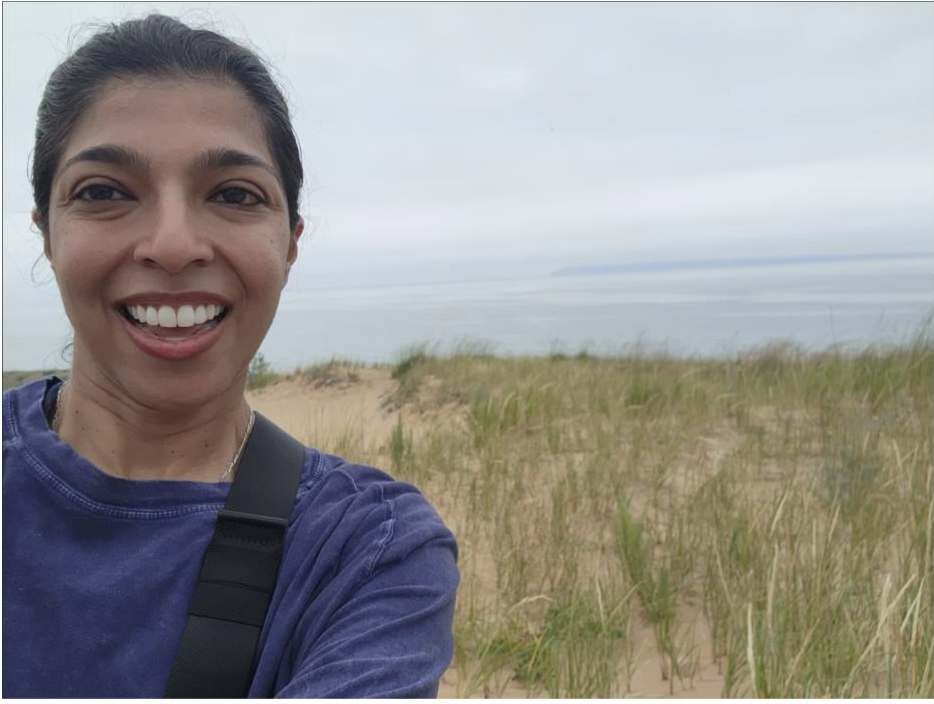
At Sleeping Bear Sand Dunes, August 2026
Early Inspirations
SPIN: What was medical school like?
UN: I went to medical school surrounded by cornfields in Northeast Ohio and, overall, really enjoyed being a full-time student. One of my first courses was neurobiology, and I remember being fascinated by the central nervous system and what it means to be human at a cellular level. At the time, I thought I might become a neurologist.
SPIN: How did your interests develop from pediatric radiology into the more specialized world of pediatric neuroradiology and fetal imaging?
UN: I started radiology residency thinking I would pursue adult neuroradiology. However, some wonderful experiences during my pediatric radiology rotations, along with the influence of a few key mentors, changed my direction.
I really enjoyed working in the children's hospital environment for several reasons: kind and passionate colleagues, more manageable clinical volumes, and most importantly, the satisfaction of helping care for children.
I ultimately decided to pursue two fellowships, first in pediatric radiology and then in pediatric neuroradiology, and was fortunate to complete both at Children's National Medical Center in Washington, D.C. It was there that I discovered the magic of fetal MRI and became fascinated by neuroimaging across the fetal-to-neonatal continuum.
SPIN: Which mentors or early experiences shaped how you lead and practice today?
UN: My fellowship program directors at Children's National, Drs. Dorothy Bulas and Gilbert Vezina, were instrumental in shaping my clinical and academic interests.
Dr. Bulas's passion for fetal imaging was infectious. I remember sitting with her in the reading room, watching her lead multidisciplinary conferences and counsel expectant mothers, and being struck by how meaningful this work could be. Dr. Vezina, who is also an incredibly gifted teacher, helped me appreciate the close connection between fetal imaging and everyday pediatric neuroradiology.
When I joined the faculty at Cincinnati Children's, I was fortunate to find another wonderful mentor in Dr. Beth Kline-Fath. Her academic interests aligned so closely with mine, and her seemingly endless passion and energy for fetal imaging were both inspiring and motivating.
I've been very fortunate to learn from people who are not only exceptional physicians but also generous teachers and mentors. Their influence continues to shape how I approach my own clinical work and teaching.
Imaging the prenatal brain
SPIN: Fetal imaging often involves more than identifying an anatomical abnormality; it also means helping a family and a multidisciplinary team understand what that finding might mean for a child's future. How do you balance diagnostic precision with the uncertainty that can accompany predictions about neurodevelopment?
UN: This is such an important question! Two things have been particularly valuable to me.
First, I make an effort to follow up on postnatal imaging and clinical outcomes whenever possible. I periodically revisit fetal MRIs I've interpreted to see how the findings evolved after birth. This has taught me so much about both the strengths and limitations of fetal MRI. I also try to pull up the fetal imaging when interpreting postnatal studies or participating in NICU rounds, because looking at the images together often helps put the findings into perspective.
Second, communication with the fetal and neonatal care teams is incredibly important. I always say there is no such thing as too much communication! I learn a tremendous amount from my interactions with the physicians and staff caring for these patients, both before and after birth.
Fetal imaging is rarely about one image or one diagnosis. It is about understanding the larger clinical picture, communicating what we know, being honest about what we don't know, and helping the team and family make the best possible decisions.
“I always say there is no such thing as too much communication!”
Innovations
SPIN: Pediatric neuroradiology is evolving rapidly. What innovations excite you most?
UN: A couple of things come to mind.
First, AI-based MRI reconstruction techniques have shown tremendous promise in reducing scan times while maintaining or improving image quality. For me, the greatest benefit of shorter scans isn't necessarily the ability to schedule more patients. It's the potential to improve the patient and family experience, make life a little easier for our MRI technologists, and create more flexibility in scheduling so we can accommodate the unexpected, which happens quite often in pediatric imaging!
I'm also excited about multi-contrast, single-acquisition MRI techniques, particularly when combined with AI-based reconstruction.
Finally, AI-based quantitative imaging tools are becoming increasingly accessible in clinical practice. I think these tools have real potential to complement our visual assessments, improve diagnostic precision, and ultimately help us provide more individualized patient care.
SPIN: As artificial intelligence and computational imaging become increasingly integrated into radiology, where do you think they can make the greatest difference in fetal and pediatric neuroimaging? How do we ensure that these tools improve diagnostic confidence and clinical care, rather than simply producing more sophisticated images?
UN: In fetal imaging, I'm particularly optimistic about advances that improve image quality, such as slice-to-volume reconstruction, and tools that can reduce the time needed to interpret these complex studies.
Automated volumetric assessments of the fetal brain may eventually reduce our reliance on manual linear measurements in many situations. Similarly, AI-based quantitative assessments of the postnatal brain could provide useful objective information to complement our more subjective interpretations.
But I think it's important that we don't adopt technology simply because it's new or produces impressive images. We need to understand whether it actually helps us make better interpretations, communicate more effectively, or improve patient care.
As a pediatric neuroradiology community, we have an important role in evaluating these technologies and sharing our experiences through research, publications, and educational forums so that they are used thoughtfully and appropriately.
“As a pediatric neuroradiology community, we have an important role in evaluating these technologies and sharing our experiences so that they are used thoughtfully and appropriately.”
Personal Reflections
SPIN: Is there a patient or clinical encounter that has stayed with you that reminded you of the human significance of your work?
UN: A few years ago, I received an unexpected email from a patient's parent thanking me for identifying a Chiari I malformation on a sinus CT. The finding turned out to be clinically significant, as the patient had a holocord syrinx and ultimately required posterior fossa decompression.
As radiologists, particularly those of us who aren't routinely patient-facing, we don't often hear directly from patients or families about the impact of our work. That email meant a lot to me.
I know it sounds cliché, but there really is a patient behind every study we interpret, and we have the potential to make a meaningful difference in that person's life. I try hard not to take that responsibility for granted.
SPIN: Three things about you that only a few know!
UN: First, I was born in the United Kingdom, and my family moved to the United States when I was four years old.
Second, while my husband (an interventional radiologist) is a proud Wolverine, I am a Buckeye. I just try to keep a low profile around him when one of these two teams are playing 😊
Third, I'm an Ashtanga yoga enthusiast, although these days I spend more time dreaming about a regular yoga practice than actually maintaining one!
SPIN: What helps you maintain perspective and make room for the things that matter outside medicine? What's your go-to stress buster?
UN: Definitely my children!
As much as I love my job, it can certainly be stressful at times. Coming home to my kids has a way of making those worries seem much smaller. Of course, sometimes they just replace my work worries with entirely new ones, but that's okay!
They have a wonderful way of reminding me what really matters, and they keep me grounded. Spending time with them is probably the best way for me to reset after a long day.
Legacy and Impact
SPIN: What do you hope your legacy will be in the field of pediatric imaging or pediatric neuroimaging?
UN: More than anything, I hope I'll be remembered as someone who was kind, honest, and had integrity. Basically, a good person!
Of course, I hope I've made meaningful contributions through my clinical work, teaching, and mentorship. But I also believe that how we treat the people around us matters just as much as what we accomplish professionally.
I think we should all strive to make the room we work in a little better for the people who share it with us.
SPIN: What wisdom would you share with the next generation of SPIN radiologists fascinated by pediatric neuroradiology and/or fetal imaging?
UN: I would tell them that while the road to this career is long and not always straightforward, all those years of training are absolutely worth it!
Find mentors who inspire you, remain curious, and don't be afraid to explore opportunities that might take you in an unexpected direction. I certainly didn't start residency thinking I would end up doing fetal MRI!
I feel incredibly fortunate to do work that I love, alongside colleagues who inspire me, in an environment where I feel supported in providing the best care possible. I hope the next generation finds that same sense of purpose and fulfilment.
“I believe that how we treat the people around us matters just as much as what we accomplish professionally.”
Usha D. Nagaraj, M.D.
Director, Pediatric Neuroradiology Fellowship
Professor of Clinical Radiology
Cincinnati Children's Hospital Medical Center, University of Cincinnati